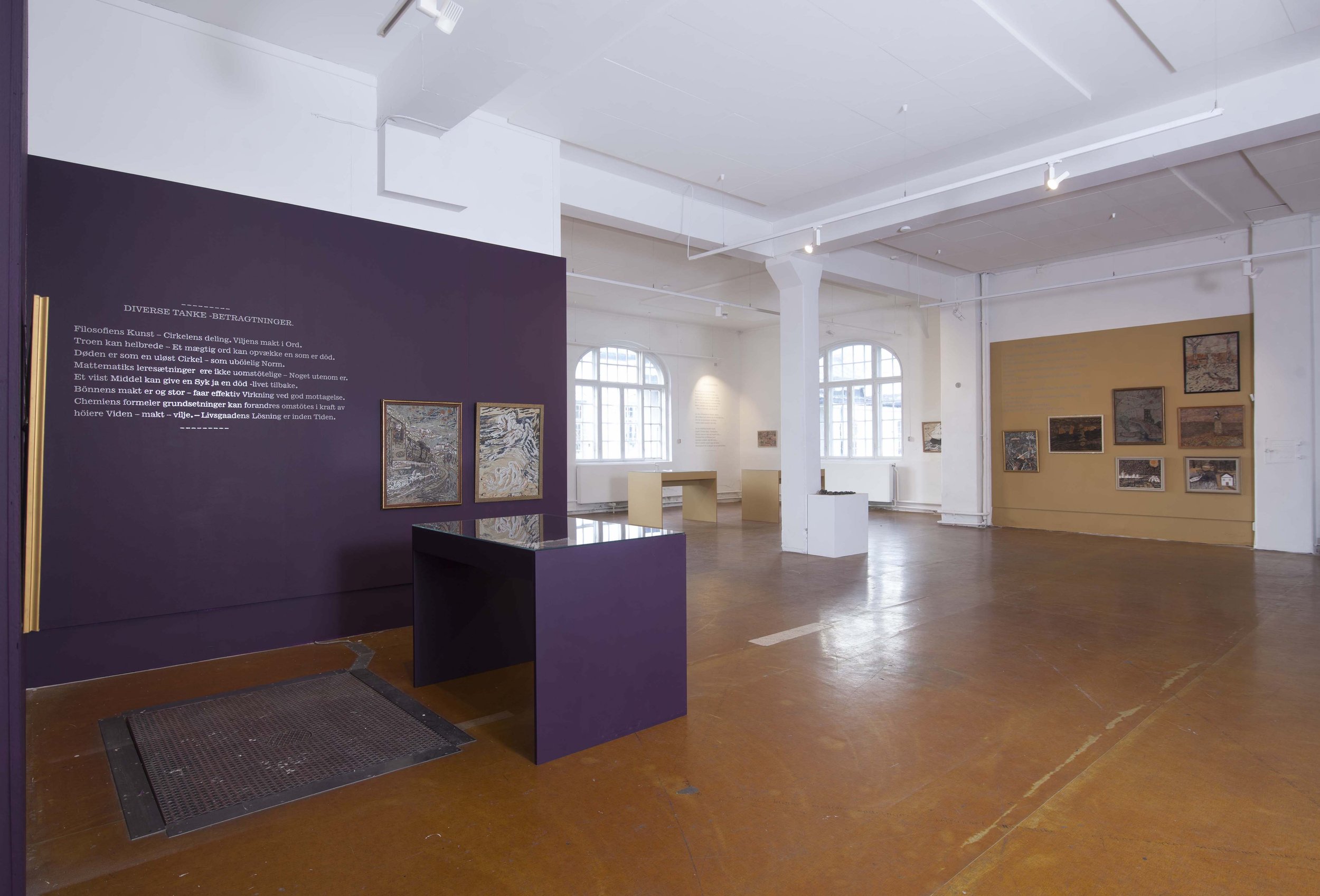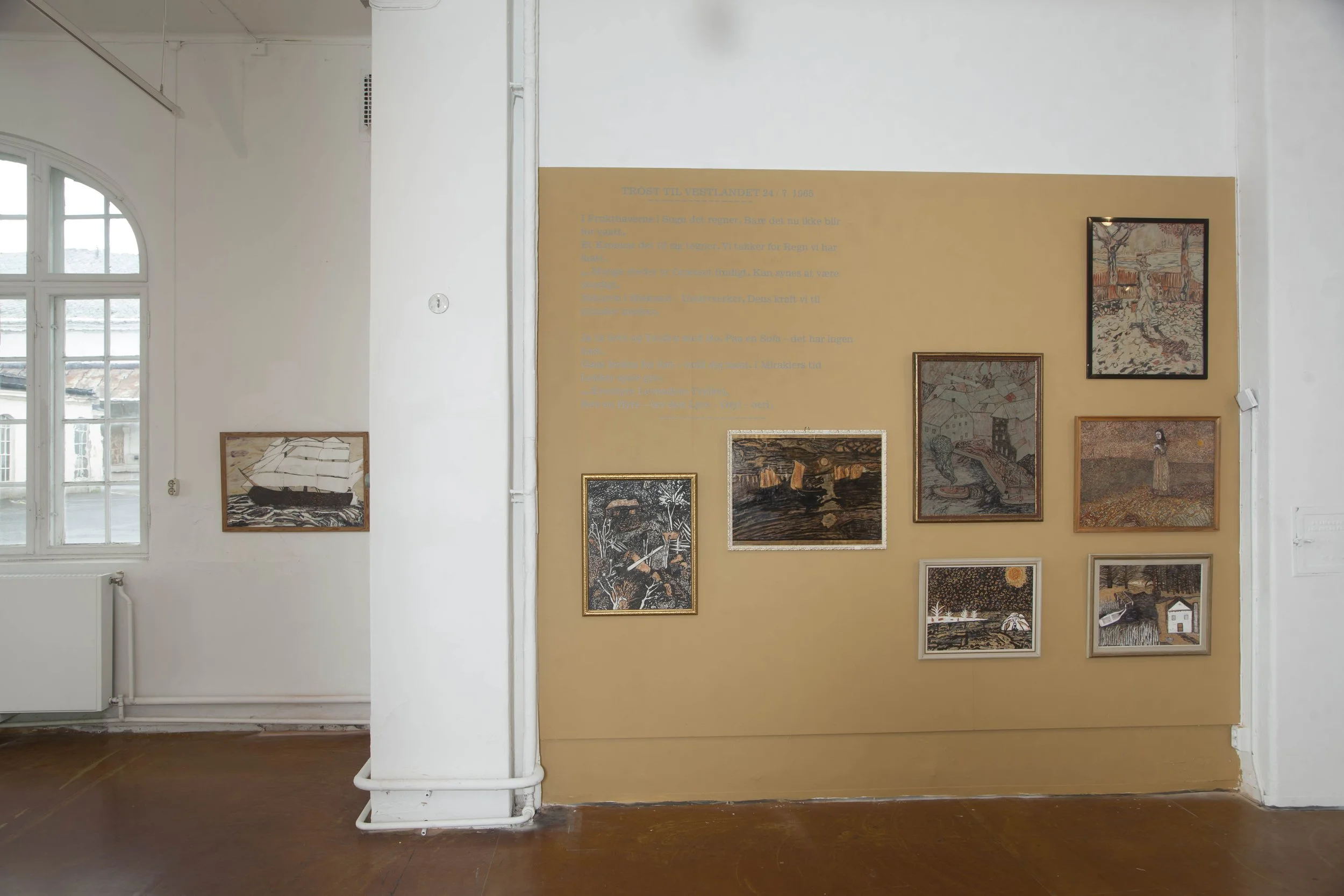


TRIOPOLIS Outsider art from the Dikemark collection
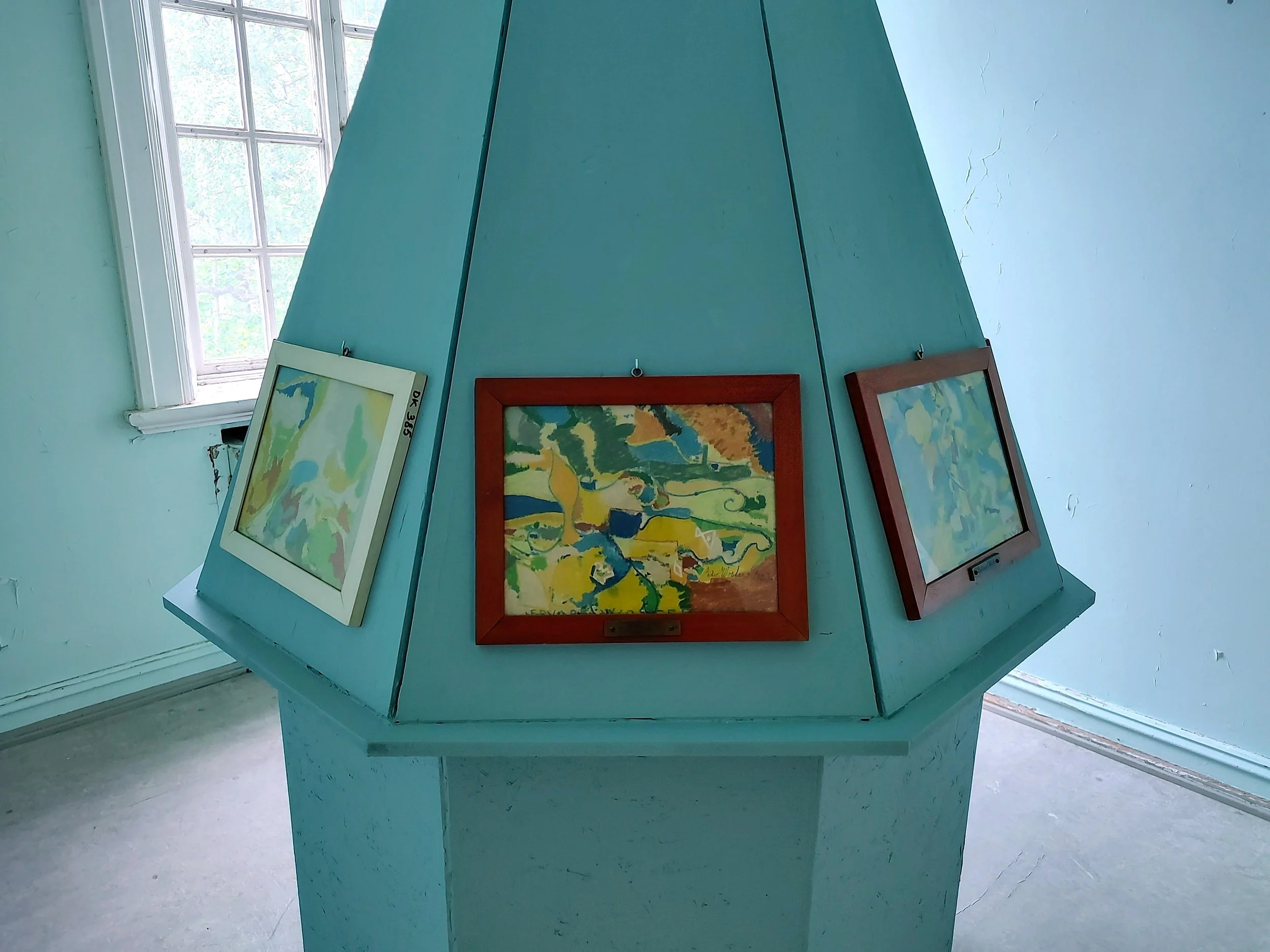
REKREASJON 1.June- 10th.October 2024
Curated by Anne Siv Falkenberg Pedersen
Produced by Trafo Kunsthall
Excerpt from the catalogue text
Dikemark Psychiatric Hospital Museum OUS, established in 1984, is the first psychiatric history museum in Norway. Since 2005, it has been housed in the Bjørkeli hospital pavilion, which opened to patients in 1919.
The museum has an extensive collection of cultural historical objects and a large art collection consisting of around 1,450 works created by former patients at the hospital, primarily from the period 1920-1950, before antipsychotic drugs (Chlorpromazine) were introduced into treatment in the early 1950s. The content of the collection is broad and includes drawings, paintings, sculptures and embroidery.
Outsider Art or Art Brut are terms used to describe art created by practitioners outside the usual art sphere, such as people with mental illnesses and/or intellectual disability. Not all patient art can be described as Outsider Art, but the three artists presented in this exhibition can be said to be examples of this by virtue of their autonomy and uniqueness.
Woster, R.J. and Beethoven were all patients at Dikemark Hospital in the period 1920 to 1940. They are distinguished by their own expression that cannot be linked to organized activity in the form of still life or similar, as there are also examples of in the collection. Rather, we assume that they have been encouraged to express themselves to some extent and have also been given adequate materials for precisely this. This is historical Outsider Art, and to the greatest extent timeless and socially relevant works. They link to the theme of "Recreation" as a superstructure both as what we believe may be early attempts at art therapy under the auspices of the hospital, and as the patient's attempt to re-create himself through an artistic process.
Curatorial projects
Exhibitions curated for Trafo Kunsthall at Dikemark kunstarena
WHAT IS MY STORY? with Wenche Nilsen & Mon Schjelderup
Curated by Simone Ritter & Anne Siv Falkenberg Pedersen
Produced by Trafo Kunsthall
4 November 2023- 28 January 2024
The exhibition What is my Story? is a celebration of the bodily skill inherent in the act of creation. This acquired skill arises from the encounter with the sensory and tangible qualities of the material and from the creative action itself. Creative processes redefine the world and can also serve as a foundation for one’s sense of self - they embody both internal and external life. Nilsen and Schjelderup’s embroideries exude a unique and powerful presence that stands in stark contrast to the artists’ life circumstances.
The exhibition is a continuation of the ongoing effort to elevate marginalised artistic practices in Norway. The ambition is to display and bring attention to the art from Dikemark and Trastad Collections/National Center for Outsider Art (Trastad Samlinger / Nasjonalt Senter for Outsider Art) and to situate it in a contemporary context. What is My Story? is a collaboration between Trafo Kunsthall, Trastad Collections / Sør-Troms Museum and Dikemark Psychiatric Hospital Museum (Dikemark Psykiatriske Sykehusmuseum).
Translation by Ella Jahr Nygaard
Both photos Kunstdok/ Tor Simen Ulstein


HEINRICH NIKES
11 February - 26 March 2023
The exhibition is a collaboration between two institutions:
Trafo Kunsthall and Dikemark Psychiatric Hospital Museum
Curated by Anne Siv Falkenberg Pedersen
Produced by Trafo Kunsthall.
Trafo Kunsthall is pleased to announce the opening of the exhibition “Heinrich Nikes”. Since 2016, Trafo Kunsthall and Dikemark Psychiatric Hospital Museum (PHS) have been working in close collaboration and produced several exhibitions with the aim of promoting art made by people with mental illnesses.
The exhibition “Heinrich Nikes” represents an important milestone to this ambition. For the first time, the name and identity of a former patient is disclosed, and his artistic work is placed within a larger cultural and art historical context.
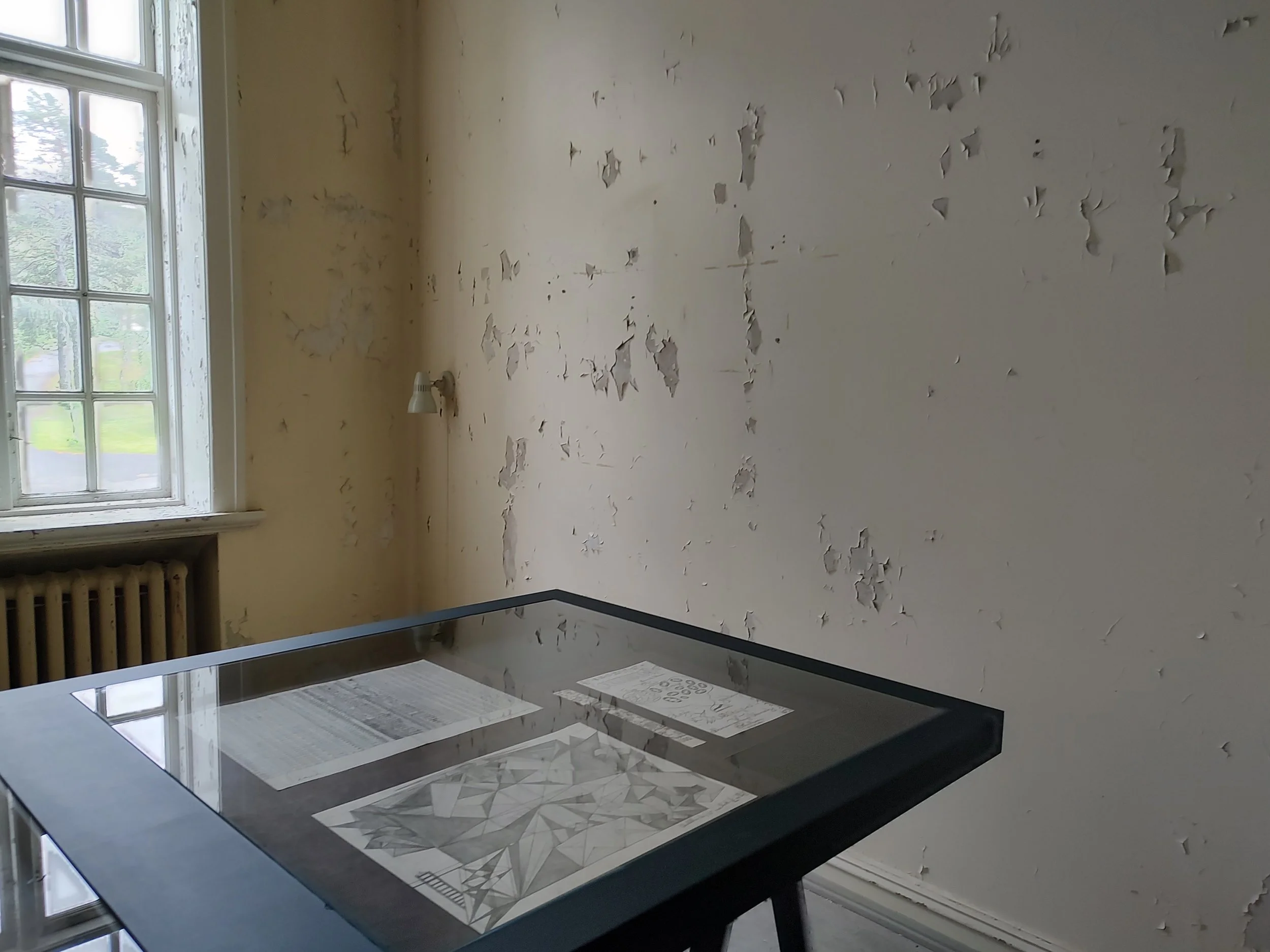
The Dikemark Psychiatric Hospital Museum opened in 1984. Since the beginning, it has been devoted to offering new insights into the history of mental illness in Norway. The museum houses an extensive collection of historical artefacts and art. In total, the collection contains some 800 artworks (550 framed works and 250 works of diverse character). These were created by former patients at Dikemark Psychiatric Hospital. The majority of the works date back to the period between 1920-1955, a time prior to the introduction and use of antidepressants and antipsychotics in treatment of psychiatric conditions. The works have been collected and preserved mainly owing to considerable voluntary efforts of representatives at Dikemark PHM. (Museumsforumet på Dikemark).
Publicly accessible records contain some information about the life of Heinrich Nikes. He was born in Vienna in 1887. His father, Ferdinand Nikes, immigrated to Norway from Austria in the late nineteenth century. Norwegian goldsmiths would often employ craftsmen and skilled workers from abroad, and goldsmith David Andersen was no exception. In the 1880’s, Ferdinand Nikes was employed as foreman at David Andersen, specialising in enamelling. He was described as an exceptional craftsman and chemist. For several years, he worked closely with the legendary designer Gustav Gaudernack who was employed by David Andersen in 1892 as a modeller and designer. The skills of Norwegian goldsmiths were internationally acclaimed, and their contribution to the 1900 Paris Exposition and The St. Louis World’s Fair in 1904 was received with praise.
Heinrich was a trained engraver and he worked for David Andersen for a brief time. He was also a competent violinist. From 1917-1931, he was a patient at Dikemark and during these years, he produced approximately 100 artworks. Several pastel, coal and pencil drawings are still in good condition, as well as some watercolour paintings.
In 1922, the book “Bildnerei der Geisteskranken” (“Artistry of the Mentally Ill”) by Hans Prinzhorn was published. The book represents one of the first attempts at analysing the artistic work of the mentally ill. Since its publication, it has been widely acknowledged in scientific circles and has been a source of inspiration for artists such as Jean Dubuffet and the surrealists. Around the same time, the patients at Dikemark produced a large number of drawings and paintings.
Heinrich Nikes’s life and art can be viewed in light of the historical conditions of the early twentieth century. Norway’s independence as a nation-state was still in its infancy and these were formative years for the nation building project. Also, the characteristic Jugendstil architecture adds a certain historical ambience to the former hospital facility at Dikemark.
The exhibition raises important questions about intellectual property rights, privacy protection and the dilemma between an institution’s duty of confidentiality and an artist’s right to professional recognition. As a result of much laborious work, applications of access have now been approved and the work and biography of an intriguing and fascinating artist can finally be exhibited to the public.
The exhibition is supported by the Municipality of Asker, Viken County Municipality, Fargerike Asker, and The Fritt Ord Foundation.
Translation by Ella Jahr Nygaard
«Croesus» // KRØSUS
12 September - 31 October 2021
Curated by Anne Siv Falkenberg Pedersen
Produced by Trafo Kunsthall
An exhibition curated by Trafo Kunsthall in cooperation with Dikemark Psychiatric Hospital Museum. ( Dikemark PHM )
The exhibition was conceived by Trafo Kunsthall, and it is the third time that the two institutions have collaborated to show the excellent and varied collection of art by former patients at Dikemark PHM.
Dikemark PHM, which opened in 1984, was the first museum wholly dedicated to conveying the history of psychiatry in Norway. The museum has a collection of around 1000 works produced by former patients at the hospital.
Since the 1920s the hospital has been a leader in its field, with in-depth, internationally renowned research by Dr. Rolv Gjessing and many others.
This is the first time an extensive exhibition has been held on the life and work of “Croesus”. The exhibition shows some 40 works of his as well as numerous examples of his texts and poetry.
An artist such as “Croesus” would be easy to define as an Outsider artist. In Norway the art of the mentally ill has been an under-communicated part of our common art history until quite recently – partly because of the stigma attached to the field of psychiatry. In many other countries, Outsider Art is acknowledged, and the artist/ patients are presented with their full biographies. However, this is still impossible in Norway due to the dichotomy between the Copyright Act and data protection laws, which is especially strong concerning medicinal records. Since 2016 Trafo Kunsthall has produced a series of exhibitions which seeks to remedy this. In showing art from the Dikemark collection, we aim to render visible the hitherto largely invisible art history that has been created by the mentally ill and other marginalized groups.
The exhibition is supported by The Fritt Ord Foundation, The Bergesen Foundation, The Norwegian Arts council, the Municipality of Asker and Viken County.
Curated by Anne Siv Falkenberg Pedersen / Trafo Kunsthall. Translation by ASFP & Derek Zinger. Both photos Jens Hamran